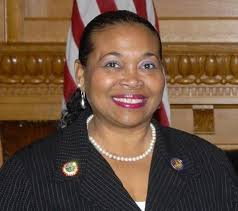
2026:
HB 2274 Veterans' Assistance Bill --
-- including SB 106 Homeless Veterans' I.D.
Over the last two years, Sen. Faust-Goudeau has
led the charge for Senate Billl 106,
to provide alternative forms of identification for indigent and homeless veterans...
-
permitting homeless veterans to use alternative forms of proof of identity and residency when applying for nondriver identification cards;
- eliminating fees for homeless veterans to obtain birth certificates and nondriver identification cards;
This year, she got it bundled with House Bill 2274, the Veterans' Assistance Bill, which also makes it easier for veterans to get occupational licenses, and added in Senate Bill 200 establishing Kansas as a "Purple Heart State" to honor those veterans wounded or killed in service.
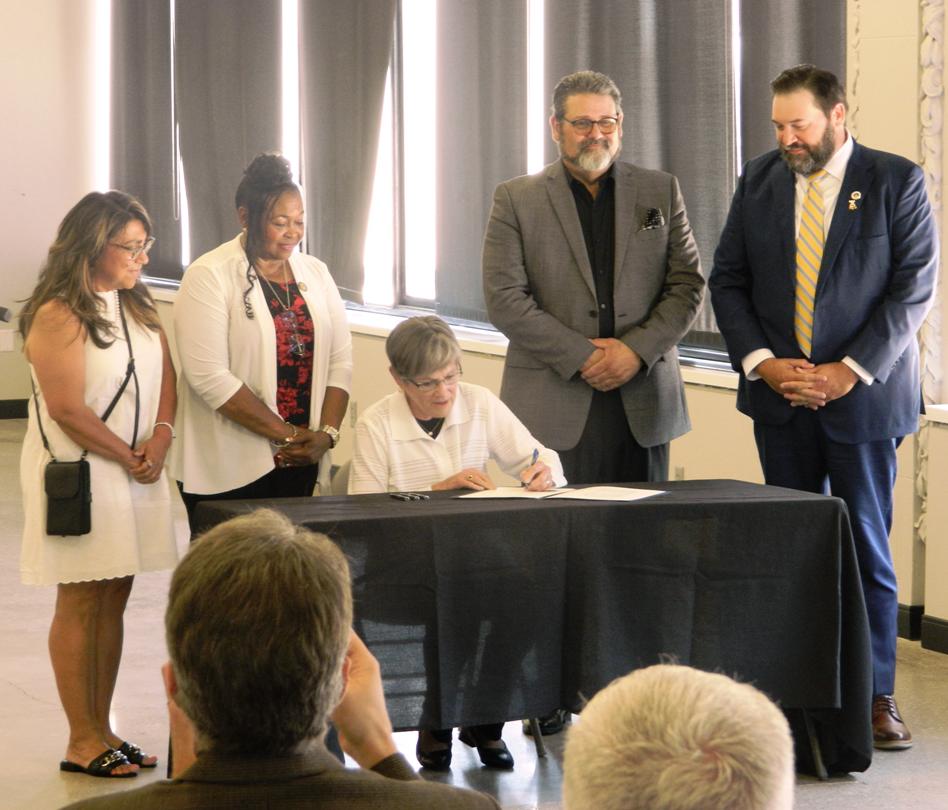
Oletha got the bill passed through both houses with virtually unanimous support, and signed into law by the Governor.
See:
"Gov. Laura Kelly signs bills about homeless veterans, utility regulation and construction lawsuits"
March 13, 2026, Kansas Reflector
As homeless advocates report, nationwide,
veterans are among the people most afflicted by homelessness. And they report one of the principal difficulties keeping the homeless down is the near-impossibility of getting employment, if they have lost their identification documents -- as the homeless commonly do, for various reasons having to do with their living conditions.
Without proper I.D., it's impossible to get a legal job. This is because -- to ensure that American jobs are only open to citizens, or to foreigners legally authorized to work here -- the federal government instituted strict employer requirements: demanding that employers certify that they have checked an employee's documents, before hiring them, to be sure they are entitled to work in the United States.
But, ironically, those who have defended our nation are, too often, unable to prove that they are entitled to work here, having lost their documents -- birth certificates, driver's licenses and military ID's -- in the chaotic, frequently relocating life of a homeless veteran.
Oletha has argued,
for years,
that these American patriots deserve easier access to proof of their identity, and right to work in the nation they've defended. So she proposed a bill to get the state to provide them needed identification -- and an address for them to use for essential related communications -- so they can get a job, and lift themselves from the indignity and hardship of homelessness.
After years of battling for their right to work,
Senator Faust-Goudeau managed to get that bill integrated into
a larger bill containing additional accommodations for veterans,
and pushed the whole new bill through the legislature this session.
March 12th, it was signed into law by Governor Kelly.
SB 353 - Kansas Railroad Hall of Fame
Sen. Faust-Goudeau
introduced
Senate Bill 353, establishing the Kansas Railroad Hall of Fame,
and pushed it through to overwhelming victory in both houses of the Legislature, and the Governor's signature. It becomes law this summer.
At the center of the nation, Kansas is one of the pivotal places for American transportation -- particularly legendary for its historic railroads, including the Kansas-Pacific, and the enduring Atchison, Topeka & Santa Fe Railroad ("AT&SF", or simply "Santa Fe Railway") long headquartered in Topeka, before its merger with Burlington Northern, into "BNSF."
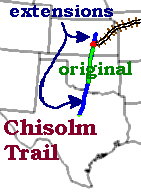
Kansas "cattle towns" -- like Abeline, Newton, Wichita, Dodge City -- gained their initial burst of wealth, and Wild West fame, as the points where cattle drives herded Texas Longhorns up to Kansas, along the Chisolm Trail, from Oklahoma, Texas and New Mexico, in the largest mass-migration of livestock in history, to meet the railroads stretching into Kansas from the East.
As Kansas became the nation's leading wheat producer, railroad trains delivered the grains of "the Breadbasket of America," and oil from new oil fields, to the rest of the nation, and beyond, as they still do, feeding and fueling America and the world, today.
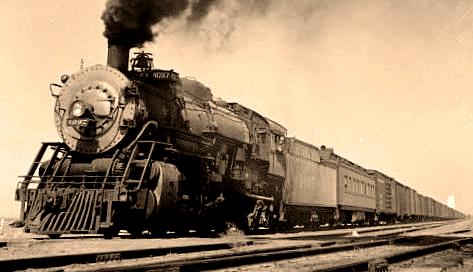
A giant steam locomotive of the Atchison, Topeka
& Santa Fe Railroad, pulls a long train out of
Wellington, Kansas, bound for Oklahoma, 1943. Wichita's Great Plains Transportation Museum
has one of these.
Courtesy Library of Congress.
Numerous other railroads have crisscrossed the state, spreading the wealth of Kansas farms, fields and factories across the nation, while transporting the riches and people of America coast-to-coast.
The Kansas and Oklahoma ("K&O") Railroad is headquartered in Wichita today, and Amtrak's historic east-west passeenger route, connecting the Great Lakes with the American Southwest and southern California, crosses Kansas on the old ATSF line, nearing Wichita at Newton.
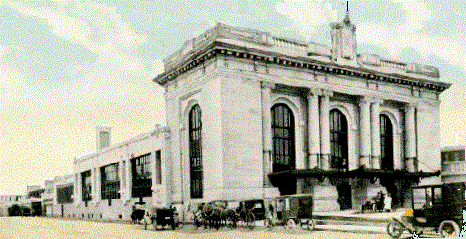
Our own grand Union Station is a strong reminder that Wichita, too, was once a passenger train destination -- and key dedicated Wichita leaders are working to make that a reality again.
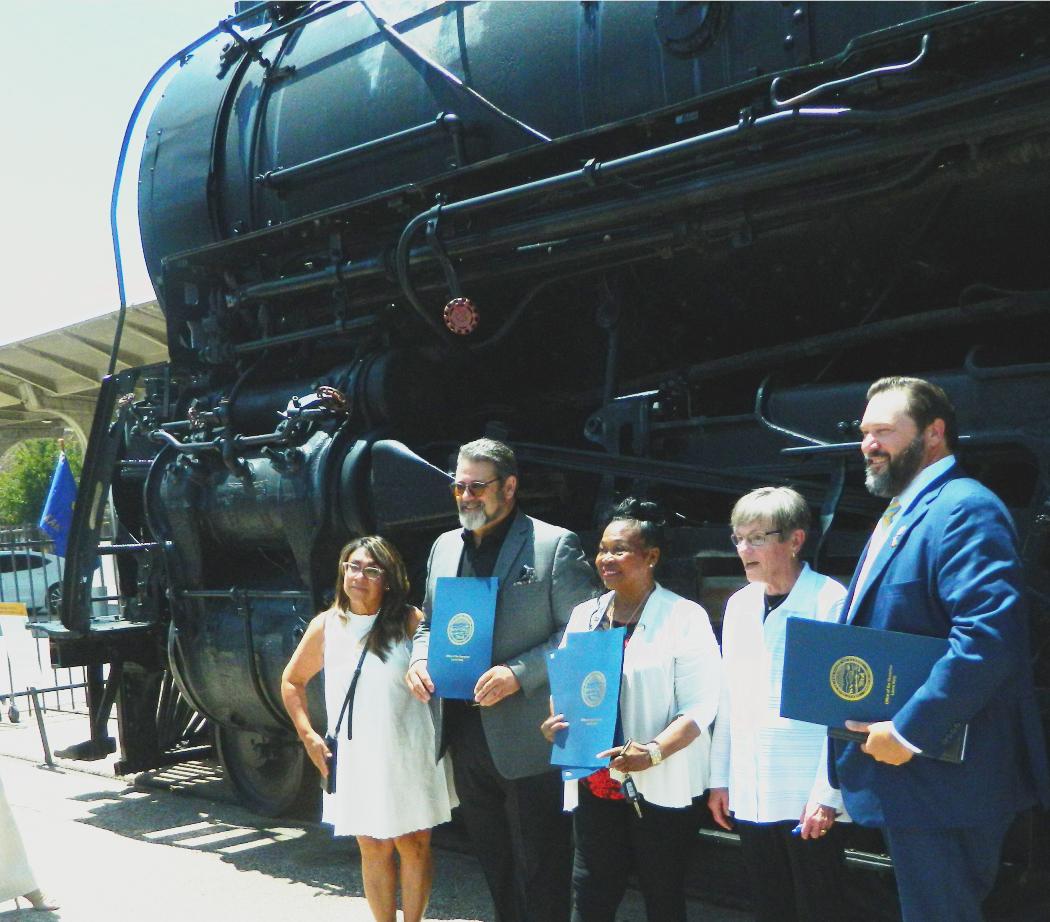
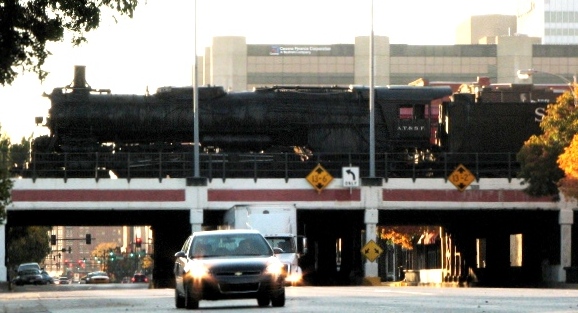
Kansas railroad history cries out for recognition, and the Great Plains Transportation Museum, in downtown Wichita, has long been working towards showing off our railroads' powerful past and present. The Museum, squeezed into a narrow 2-story brick building at the east side of the railroad overpass on Douglas Ave., across from Union Station, is home to one of the last great AT&SF steam-powered locomotives, more-modern locomotives, and various rail cars and railroad equipment, vintage and modern.
Now, the Museum has sought to become site of the state's official railroading "Hall of Fame," to honor and commemorate those who most notably made Kansas one of the world's great railroading centers.
Senator Faust-Goudeau has
promoted
and
pushed
the
required bill (SB 353)
to passage,
to officially designate and establish Wichita's own "train museum" as home of the new "Kansas Railroad Hall of Fame."
2025:

SB: 255 - Second Look Act:
Criminal Justice Reform
Second Look Act:
Proposal to reconsider excessive sentences
for the Young, the Elderly, and the Reformed.
Oletha's years of work to bring greater sanity and sobriety to prison sentences, lately, took a profound turn. Oletha has proposed a bill that would potentially shorten some of the prison terms for certain convicted criminals -- especially long prison terms of the young, the elderly, and the reformed.
The bill would create a Second Look Act -- a law that would make certain offenders eligible, after several years in prison, to have a court reconsider the sentences imposed on them. Evidence of reform, and that the individual no longer posed a danger to society -- along with factors such as age or a veteran's PTSD -- could be factored in to a re-sentencing.
The Young:
In recent decades, psychiatric researchers and criminologists have established that adult brains are not fully matured until around age 25 (a fact reflected in the sharp decrease in crimes after that age group, and sharply lower car insurance rates for those over 25).
Under Oletha's proposal, those who were convicted of crimes when children (under 18), could be reconsidered after 10 years in prison. Those whose crimes were committed between age 18 and 25, would be similarly eligible.
The Elderly:
Oletha's bill offers hope for others, as well. People convicted for crimes committed when over 50 could also be eligible for reconsideration after 10 years (long prison sentences take a disproportionately large percentage of their remaining life, and elderly prisoners often wind up serving unofficial life sentences, because they die of old age, in prison, before they can complete their sentence).
Others:
People who committed their crime between ages 25 and 50 would have to wait longer -- 15 years.
Military veterans suffering from PTSD that had not been factored into the crime could be resentenced after 10 years.
Finally, those who violated laws that subsequently were revised or rescinded, could be eligible for resentencing, as well.
A Reform Whose Time Has Come:
The concept is not completely new. Other states have toyed with the idea. In arch-conservative Florida, a similar law gained bi-partisan support -- passing that state's legislature unanimously. Charles Koch's Republican-leaning national Libertarian lobbying organization -- Americans for Prosperity -- has shown interest in the concept, as well.
The Second Look bill (SB 255) awaits a committee hearing in the Senate.
See:
Jan. 13, 2025:
"Young Kansas inmates could get a second chance
with proposed resentencing bill"
KMUW-FM News (89.1, Wichita)
also at:
Butler County Times-Gazette
(by The Beacon)
Jul. 24, 2024:
"'Second Look' Movement Could
Cut Prison Rolls, Save Tax Money"
Crime & Justice News
National Criminal Justice Association
May 15, 2024
"Report: The Second Look Movement:
A Review of the Nation’s
Sentence-Review Laws"
The Sentencing Project, Washington, D.C.
May 9, 2024
"Second Look Sentencing"
Nat'l Assn. of Criminal Defense Lawyers
Sep. 6, 2023:
"Second-Look Sentencing:
What is Working?"
American Bar Association
Feb. 9, 2023:
"New Study Finds Wide Support
For 'Second Look' Sentencing"
Crime & Justice News
National Criminal Justice Association
2024:
SB500 - VICTORY !
Driver's License Law:
Limited Restoration of
Revoked Driving Privileges
Oletha's years of work to restore limited driving privileges to those with revoked drivers' licenses -- so they can drive to work, to earn their way out of court debt -- has led to this year's
Senate Bill 500,
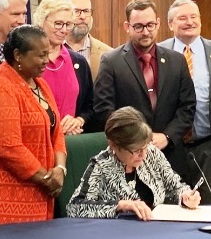
which she pushed through to victory. The bill passed both houses in the Legislature with nearly unanimous bi-partisan support (just a single Senator voted "no") -- and even support from the state's leading law-enforcement organizations. On Friday, May 10, Governor Kelly signed the bill into law!
Senator Faust-Goudeau had, in prior sessions,
won bipartisan support
to restore limited driving privileges to those with suspended licenses (except those convicted of seriously dangerous offenses, such as drunk driving) -- to allow the suspended drivers to attend to basic necessities (such as work, medical errands, getting their kids to-and-from school, and meeting legal obligations) -- while paying off their fines at a rate they can manage.
This
revolutionary
change in Kansas traffic law breaks the cycle of desperation in which poor and working class drivers are crippled by fines they cannot immediately pay in full -- resulting in the suspension of their driver's license, which -- ironically -- keeps them from meeting their basic needs and obligations, ...including the need to get to work, to earn the money, to pay off those fines, and to get to court to resolve the issue.
Now, both "revoked" and "suspended" drivers can have limited driving privileges to meet these needs,
ending most driver's license suspensions in the State of Kansas -- and breaking the law's self-reinforcing cycle of despair that has impovershed so many Kansans and their families.
This year, Sen. Faust-Goudeau
broadened her campaign
to extend these needed privileges to those with revoked licenses. To this end, this year, Sen. Faust-Goudeau introduced Senate Bill 500,
which takes effect on January 1, next year.
The new law...
-
Generally speaking, changes "failure to comply with a traffic citation" (K.S.A. 8-2110), now allowing the court to determine how a person can achieve substantial compliance with the traffic citation by...
- following the orders of the court,
...instead of...
- requiring a person to pay all fines, court costs, and penalties.
Before restricting or suspending an individual's driving privileges, the court shall consider, instead...:
- Modifying fees, fines and court costs by
- waiver or reduction
- allowing for payment plans
- Alternative requirements in lieu of restriction or suspension of driving privileges,
including:
- alcohol or drug treatment, or
- community service.
-
If a person fails to comply with those softer terms, the court tells the Division of Vehicles to suspend the person’s driving privileges until satisfactory evidence of substantial compliance with the terms of the traffic citation has been furnished to the court -- unless such person is eligible for restricted driving privileges.
HOWEVER,
if the person is eligible for restricted driving privileges, the Division of Vehicles shall, instead, notify the violator that their driving privileges are simply restricted as provided below.
-
If a person's driving privileges have been revoked -- solely for driving when such person's privilege to do so was canceled, suspended or revoked for "failure to comply with a traffic citation" -- they may make a written request to the Division of Vehicles for restricted driving privileges.
Upon review and approval of the driver's eligibility, the driving privileges will be restricted -- instead of revoked -- by the Division of Vehicles.
-
EXCEPTIONS: A person shall NOT qualify for restricted driving privileges (under note 2 or 3 above) if such person...
- has been convicted for driving with a canceled, suspended or revoked license more than three times, or
- is suspended for reasons other than a "failure to comply with a traffic citation" at the time of application.
-
A person granted restricted driving privileges (under note 2 or 3 above) is allowed to drive to-and-from...
- dropping off (or picking up) children
from school or child care,
- purchasing groceries or fuel,
- religious worship services,
...in addition to other circumstances already allowed under current law, such as:
- employment,
- schooling,
- health care,
- etc..
-
Several traffic violations NOT involving the operation of a motor vehicle will no longer provide the basis for a violation of "failure to comply with a traffic citation." (Current law is limited to citations for illegal parking, standing, or stopping.)
This provision is retroactive, so a person who committed "failure to comply" (based on one of the specified violations) may petition the district or municipal court in which the person should have complied with the traffic citation.
Then, if the court determines that the person committed an offense that does not provide the basis for a violation of the amended section, the court shall immediately electronically notify the Division of Vehicles to terminate any restriction, suspension (or suspension action) that resulted from the violation.
-
Finally, there is a RETROACTIVE “look-back” provision that
-- if any conviction for a "failure to comply" is greater than FIVE YEARS old --
it shall NOT be considered by the municipal or district court, nor the Division of Vehicles, in determining suspended or restricted driving privileges.
After five years have passed from the date of conviction, the Division shall notify -- by mail -- any individuals whose driving privileges were suspended or restricted, and whose driving privileges have not since been restored.
The Division shall notify the individual that they may be eligible for driving privileges because five years have passed since their conviction for the "failure to comply."
After much political wrangling, in both House and Senate, Sen. Faust-Goudeau managed to coax an overwhelming
BI-partisan majority of legislators -- backed by the state's top law enforcement organizations -- to support, even strengthen, the bill, passing it overwhelmingly, and earning a prompt signature from Governor Kelly.
Those poor and working-class families caught in the downward spiral of traffic-fine debt, and strangled freedom of movement, can now have a sound, reasonable way to work their way out of the predicament, and earn restoration of their full driving freedom -- improving the future for them, their families, employers, and the community -- while relieving a senseless burden on law enforcement and the courts.
That's Progress !
See:
Anthony Hensley Award
At the Kansas Democratic Party convention -- "Washington Days" -- Sen. Faust-Goudeau was honored with the Anthony Hensley Legislative Award for outstanding service in the Kansas Senate.
The honor is named for the former longtime Senate Minority (Democratic) Leader, Anthony Hensley, who -- along with current Minority (Democratic) Leader Dinah Sykes and Lt. Governor David Toland -- participated in the presentation of the award to Oletha.
Presenting award to Sen. Faust-Goudeau (center) are
(left-to-right):
Sen. Ethan Corson,
Rep. Barbara Ballard,
former Senate Democratic Leader Anthony Hensley,
Lieutenant Governor David Toland, &
current
Senate Democratic Leader Dinah Sykes.
On
International Women's Day, March 8th,
fourteen women were presented with the 2024 Shine Awards,
which honor
"inspirational Kansas women"
--
"recognized for empowering others and improving their communities."
Senator Faust-Goudeau was among the honorees, noted for service "on several boards and committees," and for introducing "several bills that have received bipartisan support."
The awards banquet, held this year at the Wichita Art Museum, helps raise funds for Storytime Village’s mission to inspire a "lifelong love of literacy in
under-served children" in Kansas, through
its various literacy programs
-- including summer camps, the Urban Preparatory Academy in Wichita, and distribution of free books to Kansas kids.
The One Heart Project
The U.S. is one of the major countries that most frequently imprisons its kids,
and leads the industrial world in locking up young people.
And Kansas is usually
one of states most likely to do so.
Senator Faust-Goudeau is pushing for juvenile justice reforms to break the cycle of poverty, crime, jail, re-offense, prison, failure and tragic waste.
The One Heart Project
is a national juvenile offender rehabilitation program that provides second chances for youth who've been convicted of serious crimes, but show real potential for reform. It began in Texas, and has spread to major cities in several states, particularly in the heartland, including Topeka and Kansas City -- providing real rehabilitation, lasting freedom, and constructive lives for convicted kids.
The Project grew out of an extraordinary incident in the 1990s, when a Texas Christian high school partnered with the football team of their state's maximum security juvenile prison, to provide a positive experience in sports that revolutionized the lives of the prison's most promising-but-disadvantaged youth.
The inspiring story of the dramatic events that led to the One Heart Project is now a motion picture -- "One Heart" -- shortly to be released in theaters.
Senator Faust-Goudeau, seeking to build local support for bringing this program to the Wichita area, partnered with leaders in both parties, with help from Walmart and others, to arrange a private pre-screening of the movie for Wichita-area community leaders -- and to give them a chance to meet and learn from One Heart Project leaders.
At the Dunbar Theater, Feb. 24th, in one of the biggest local bi-partisan political events of the year, over 150 dignitaries -- including Congressman Ron Estes, City Council member Brandon Johnson, Police Chief Joe Sullivan, a half-dozen legislators (including Juvenile Justice Oversight Committee Chair Stephen Owens), community activists, and more -- showed up for the event, learning about a new way to keep our community's kids from a life wasted in prison.
At Oletha's urging, lobbyist Ryan Irsik delivered a $30,000 check from Walmart to help with the project.
One Heart Project leaders were
impressed with the reception and support,
and are now eager to start a program for Wichita-area youth.
2024 Legislative Session:
FEBRUARY, 2024
NEW BILLS INTRODUCED,
Sponsored by Senator Faust-Goudeau
SB 435
Sales tax exemption for certain essential hygiene products.
Following her success in previous sessions, removing the state sales tax on food, Sen. Faust-Goudeau introduced Senate Bill 435, which allows for a sales tax exemption for certain critical personal-care items (feminine hygiene products, and baby and adult diapers) -- adding it as a floor amendment to Senate Bill 60. Following her supporting testimony in the Senate Assessment and Taxation Committee, it passed.
SB 464
Creating the Kansas minority, woman, disadvantaged and service-disabled veteran small-business-enterprise development act;
-
providing for development of such business enterprises through a program to facilitate and increase participation by such business enterprises in providing goods and services to state agencies and postsecondary educational institutions;
-
establishing the office of minority and women business development within the department of commerce to develop such program and assist state agencies and postsecondary educational institutions to establish plans and goals for such participation;
- providing for an advisory committee on certified small business enterprises that may be established by the assistant director of such office;
SB 500
An act concerning
drivers' licenses;
- authorizing certain individuals to be eligible for restricted driving privileges;
- permitting individuals with restricted driving privileges to drive to-and-from dropping off or picking up children from school or child care.
Driver's License bill - Limited restoration of revoked driving privileges.
A major problem facing poorer Kansas citizens has been the onerous burden resulting from traffic tickets and fines that exceed their ability to pay. Under such circumstances, their driver's licenses are often suspended -- causing the majority of driver's license suspensions in Kansas.
Ironically, this prevents the suspended driver from getting to work, to earn the money that they need to survive and to pay off their fines, and thereby get their licenses restored.
Those who, in desperation, continue to drive, often find themselves arrested,
charged further, burdened with greater fines, and even having their licenses revoked -- often in a cascading chain of events that started from relatively minor traffic offenses.
The snowballing effects of this problem are often catastrophically destructive to the lives of impoverished drivers, and also to their families, employers, and community as well.
Senator Faust-Goudeau, in prior sessions,
won bipartisan support
to restore limited driving privileges to those with suspended licenses (except those convicted of seriously dangerous offenses, such as drunk driving) -- to allow them attend to basic necessities (such as work, medical errands, getting their kids to-and-from school, and meeting legal obligations) -- while paying off their fines at a rate they can manage.
She's
broadened her campaign
to extend those same needed privileges to those with revoked licenses, as well. To this end, this year, she introduced Senate Bill 500.
In the Senate hearing, Feb. 15th, Oletha testified in the Senate Judiciary Committee in support of SB 500...
...which is now on its way to passage, with strong bipartisan support!
SB 508
An act concerning
veterans; relating to forms of identification;
-
permitting homeless veterans to use alternative forms of proof of identity and residency when applying for nondriver identification cards;
- eliminating fees for homeless veterans to obtain birth certificates and nondriver identification cards;
SB 421
CO-SPONSORED BILL:
by Senators Blasi, Alley, Erickson, Fagg, Faust-Goudeau, Kerschen, Masterson, Petersen and Ware
An act providing a sales tax exemption for Exploration Place, Inc.
Wichita's Exploration Place, a non-profit institution, is the state's premier science museum for young people -- providing intellectually stimulating recreation and fascinating learning opportunities for thousands of children annually, from throughout Kansas.
Delta Day at The Capitol
Senators Faust-Goudeau, Haley and Pittman introduced the following Senate resolution, which was read: